It's Not A Money Problem
It's not a money problem, it's a people problem.

Category: Education (and Other)
Title: It’s Not A Money Problem
This week, the National Assessment of Educational Progress (NAEP) was released by the Department of Education. For those of you who do not know why this document is important, it essentially gives educators data on reading and math for 4th grade and 8th grade students. Our goals are to see positive progress from 4th grade to 8th grade, as this will be an indicator for overall school growth.
I live in North Carolina, and our state is showing stagnation in reading and minor growth in math. (For a good summary for NC, please see EdNC’s Summary) I think it is no surprise that our students’ education is a top priority for our all of us. We want our students reading, writing, and doing math better than they were 10 years ago. The data, and vibes, are telling us that is not happening.
But I do want to talk about one solution that I hear continuously from educators…does adding more money actually fix educations problems?
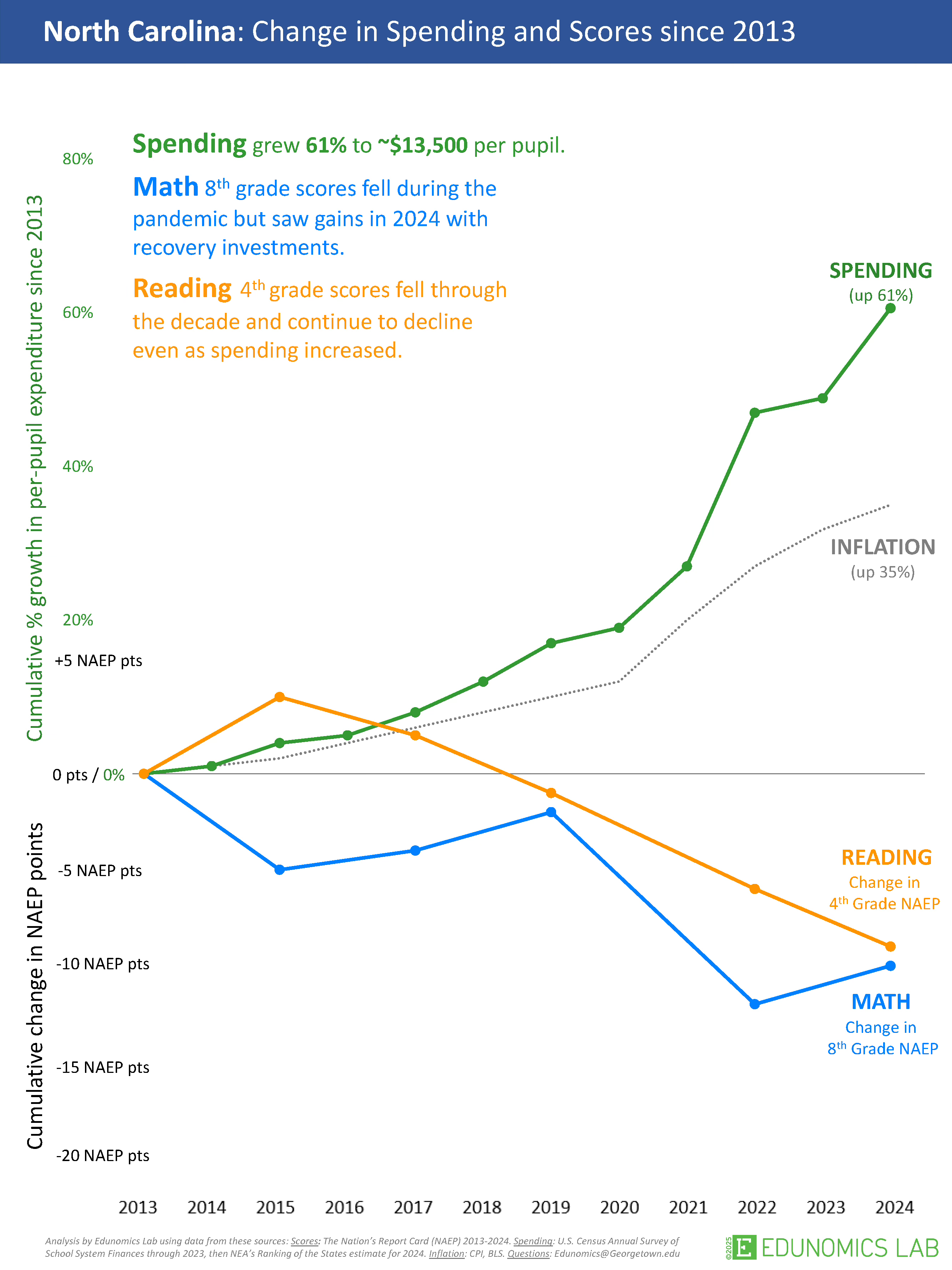
Above is a graph found through Edunomics Lab, in which they graph the US state money going towards education and compare that to the progress (or lack thereof) in reading and math scores. (Full Information Here) This essentially is asking each state “what is our return on investment in our schools?”. In North Carolina, since 2013, education spending has gone up 61%, but reading and math scores have gotten worse by 10 percentage points in that time. In South Carolina, since 2013, education spending has gone up only 45%, and reading scores are better now than in 2013, while math scores are down around 13 percentage points. The rate of inflation since 2013 is at 35%, so both North and South Carolina are outspending inflation, and the only measurable growth the past decade is South Carolina reading scores.
We don’t have a money problem…we have a people problem. Please know that I am not talking about individual people as the problem, but the need for people and the need for good people. Throwing money at a problem does not guarantee that the problem gets fixed. Having great people who have the capacity to be great innovators gets problems fixed. A common retort I hear to this claim is that “we need more money to hire good teachers”. As you can see HERE (via Georgetown University), North Carolina has more education employees now than in 2015. We have people, we just need our people to be more effective. We have to work on our people systems.
Why are our people being less effective? That goes into our systems, the strain our teachers and administrators are feeling and the pressure coming from all around them. Student needs are also more diverse than a decade ago. A teacher is no longer just a teacher…they are a counselor, a mentor, a content expert, a processor, a custodian, a coach, the list can go on. And because the problems are more complex, we need educators that are innovators and creatives that are willing to problem solve around more than just their content. Instead of investing in content experts, we need to invest in people experts.
Potential Solution: Build In Agency To Our Educators
Like I said above, our educators need to be innovators and creatives so that problem solving can happen more efficiently. I believe the best way we can impact this is to build in agency into our education systems. Teachers are great problem solvers, their innovators, they are creatives, they need to be let loose! (Resource Here Via NCES) From my own experience, I know that employers around the United States love hiring former teachers because they are problem solvers, they can document well, and they have intentionality in their work. They care. We need to bring that to the forefront of our educational systems.
How can we build agency for our educators?
First. Allow all administrators and teachers to create their own yearly goals. In my educational experiences, we were required to have one data goal and one literacy goal, and these goals were usually given to us each year. I never felt that those goals were personal to me. I want to allow all administrators to create their own school goals. I want a system that allows teachers to create their own goals for the year. For example, I personally don’t care what curriculum for social-emotional learning a school uses, what I care about is that schools do SOMETHING to address the social-emotional needs of their students. If one school wants to use one SEL curriculum, and another school wants to use a different SEL curriculum, I’m ok with that! Just like if a school wants to use one type of reading strategy, and another schools wants to use another type, we should use it as an opportunity for action research to see which students grow the most, and use that evidence to inform our practices in the future. I want our adults to have more curiosity than our students. If our students see us being curious, and working towards our goals with passion, they’ll see what it is like to strive for growth. They’ll be motivated by seeing motivation.
Second. Track those goals throughout the year, with opportunities to shift as needed. What is our goal tracking strategy? Sometimes we need a resetting of our goals. The only way we can shift our goals is by tracking them individually, reflecting on them, and allowing our goals to move and motivate us to be better. There is always more than one path to success, and sometimes we have to build a different road to success.
Three. Continually ask each other the question: What are you working towards? We have to continually speak life into each other and support each other as educators in order for us to see the progress we want to see. Education is a tough profession, and a lot of times we become fire-fighters, dealing with emergencies all day, and never addressing the goals we established. Our attention gets pushed in a billion different directions. We have to keep our attention to our goals and successes. We need each other to help us reach our collective goals!
Fourth. Provide opportunities for administrators and teachers to share what they’ve learned. We need to uplift our educators’ learning. We can learn a lot from each other. Following the action research model can allow our schools to learn from each other. We can even make this part of the evaluation process. When was the last time we asked teachers to prove what they are doing is working? Why don’t we do that? Why is that taboo? Why is the student assessment the only measurement for success? Let’s give our administrators and teachers the opportunity to prove their work is worth the effort. Let’s empower them to take the work into their own hands!
There are a lot of different ways to build agency in our administrator and teachers. I’m sure if you typed in your search-bar “ways to build agency in my school or classroom” a bunch of links and strategies come up. I do think that if we build more agency into our systems, our people will become more effective and impactful in their work. It will become more personal to them. It’s not a money problem, it’s a people problem. Lucky for us, the solution is also the people! Let’s invest in good people!
(This article is not a reflection of my current employer or organization. It is meant as a charge towards greatness. It is meant as a place to reflect on my own experiences working over ten years in public, private, and charter education. I believe we are meant for greatness, and our schools are doing great work everyday.)